
Living in Provence-Alpes-Côte d'Azur
Living in Provence-Alpes-Côte d'Azur - The Easiest Region to Fly Home From
Lavender, Marseille's markets and the Riviera coast. The only region in this guide with nonstop flights to the US — and the highest prices to match. A complete guide for US expats.
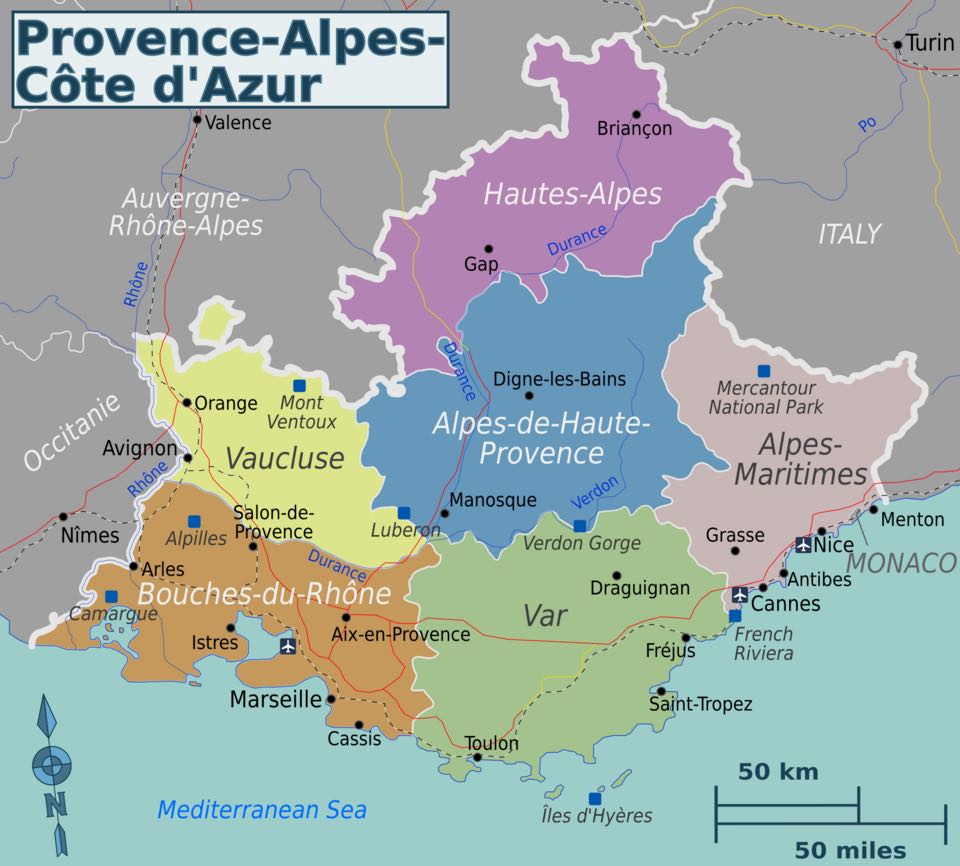
Shaundd, CC BY-SA 3.0, via Wikimedia Commons
Provence-Alpes-Côte d'Azur Overview & Character
 PACA is the region we know from the saddle before we knew it from the paperwork. It starts about forty minutes east of our door in Port Camargue — you cross the Petit Rhône, the rice fields give way to the stony plain of the Crau, and you are in the Bouches-du-Rhône without anything announcing it. We have been riding into this region for years. That is the honest basis for everything on this page, and it also explains where our knowledge thins out, which we come back to in Our Take.
The first thing to understand is that "PACA" and "the Côte d'Azur" are not the same thing, and confusing the two will cost you money. The Riviera — Nice, Cannes, Antibes, with Monaco over the border — is one department out of six. It is the one that shows up in films and in property listings aimed at foreigners. Behind it sits a region that is mostly mountain, forest and stone village, where the Hautes-Alpes have fewer people than a mid-sized American suburb.
Marseille is the counterweight, and it is the city we would point most Americans at first. France's second city, a working port for 2,600 years, and it does not perform charm for visitors. What it has instead is scale: the third-largest teaching hospital group in France, a large university, a real economy that is not built on tourism, and the Calanques — limestone inlets with water the colour of a swimming pool — inside the city limits. From June 2027 it also has a nonstop flight to New York.
Then there is the Provence of the imagination, and the surprise is that it mostly delivers. The Luberon villages really do look like that. Ventoux really does rise out of the vines like something misplaced. The Verdon gorge is the one place in Europe we have seen Americans stop comparing to the Grand Canyon and simply look. The lavender on the Valensole plateau in early July is not a postcard exaggeration; it is a traffic problem.
What PACA asks in return is money and patience with crowds. Outside Paris, this is the most expensive region in France to buy property, it attracts roughly one in five of all purchases made by non-resident buyers in the country, and in August the coast between Marseille and Nice is less a road than a car park. Both are manageable if you choose your department deliberately. Both are brutal if you assume the whole region is priced like the brochure village you fell in love with.
Departments at a Glance
PACA has six departments, and the spread between them is wider than in any other region we cover — you can pay more than twice as much per square metre in Aix-en-Provence or Nice as in Gap or Forcalquier, in the same region, on the same healthcare system. Each has a distinct character:
The Coast & City Belt (Most Popular for Expats)
Bouches-du-Rhône (13): Marseille, Aix-en-Provence, Arles, the eastern half of the Camargue and the Calanques. 2.09 million people — the most populous department in the region by a distance. Marseille gives you the infrastructure and the 2027 New York flight; Aix gives you the elegant, expensive, student-town version thirty minutes away. Arles is the one we keep going back to — Roman, a little scruffy, cheaper, and on our side of the region.
Var (83): Toulon, Hyères, Saint-Tropez, Bandol, and behind them the hill villages — Cotignac, Lorgues, Aups, the southern approach to the Verdon. 1.12 million people and the region's most dynamic department for population growth. The coast is expensive and busy; forty minutes inland, the Haut-Var is some of the best riding country in the south and far kinder on the wallet. If we were buying in PACA, this is where we would look.
Alpes-Maritimes (06): Nice, Cannes, Antibes, Grasse, Menton, and the mountain valleys behind them that most visitors never see. 1.13 million people, most of them squeezed onto the thin coastal strip below the mountains. Nice has the second-busiest airport in France and the largest established English-speaking community in the south. It is also where our own knowledge runs out — see Our Take.
Inland & Upland (Space, Altitude & Value)
- Vaucluse (84): Avignon, Orange, Carpentras, the Luberon and Mont Ventoux. 572,000 people. The fastest TGV link in the region — Avignon is 2h40 from Paris — the most photographed villages, and prices that are high in the Luberon and reasonable almost everywhere else. The weak spot is the mistral, which funnels down the Rhône corridor here harder than anywhere else in France.
- Alpes-de-Haute-Provence (04): Digne-les-Bains, Manosque, Forcalquier, Sisteron, the Valensole lavender plateau and the northern rim of the Verdon. 168,000 people spread across a big, empty department. The lowest property prices in the region and, for our money, the best roads. Thin on services, hot in summer, genuinely remote in winter. For people who mean it about rural life.
- Hautes-Alpes (05): Gap, Briançon, the Écrins, Serre-Chevalier. 143,000 people — the least populated department in PACA and one of the highest in France. This is the Alps, not the Mediterranean: a real ski season, real winters, the Col d'Izoard and the Galibier on the doorstep. We rode through Briançon in 2026 and it is spectacular, but be clear with yourself that choosing here means choosing mountains over sea.
This is where PACA beats every other region in the south, and it is the main reason an American family might choose it over Occitanie. Nice already has nonstop flights to the United States. Marseille gets one in 2027. And the TGV puts Avignon closer to Paris than Montpellier is.
AIRPORTS
- Nice Côte d'Azur (NCE) — The second-busiest airport in France after the Paris airports: 15.23 million commercial passengers in 2025, around 122 direct destinations in 45 countries, flown by 61 airlines. A Terminal 2 extension opened in April 2026 to cope with the traffic. For Americans this is the decisive fact on the page: Delta, United and La Compagnie all fly nonstop to the New York area, and Delta added a seasonal Boston–Nice nonstop on 17 May 2026, three times a week. The airport is about fifteen minutes from central Nice and is linked to the city by tram.
- Marseille Provence (MRS) — The region's other major airport, and from 2027 its second transatlantic gateway. United begins a daily Newark–Marseille nonstop on 4 June 2027 (5 June for the first departure from Marseille), on the new Airbus A321XLR — the first nonstop between the United States and Provence. It is subject to government approval, and at least one report says the first season runs to October 2027, so treat year-round service as unconfirmed until United publishes a winter schedule. Strong European and North African network otherwise, with Air France, Ryanair, easyJet, Volotea and Transavia.
- Toulon-Hyères (TLN) — Small and convenient for the Var coast. Mainly Paris and seasonal European routes. No USA service.
- Avignon-Provence (AVN) — Very small, limited and mostly seasonal service. Most Vaucluse residents fly from Marseille instead, or take the TGV.
Our honest assessment on USA flights: if you need to get back to the United States often, PACA is the region that makes it easiest. Nice gives you nonstop New York service today; Marseille adds Newark from June 2027. Everywhere else in Southern France you will mostly be connecting through Paris, Amsterdam or another European hub — Toulouse's own United nonstop to Washington Dulles starts in April 2027.
TGV & TRAIN
- Avignon TGV — Avignon TGV → Paris Gare de Lyon: 2h40 direct, around 33 trains a day. The fastest Paris connection in Southern France — quicker than Montpellier. The TGV station is outside town; a short shuttle train links it to Avignon Centre.
- Aix-en-Provence TGV — Aix-en-Provence TGV → Paris: about 3h direct. The station sits on the plateau between Aix and Marseille, not in the town centre.
- Marseille — Marseille Saint-Charles → Paris Gare de Lyon: 3h04 on the fastest direct services, around 3h20 with the Aix and Avignon stops. Trenitalia's Frecciarossa also runs on this line alongside TGV INOUI and OUIGO, which helps on fares.
- Nice — Nice → Paris Gare de Lyon: 5h40–6h direct. There is no high-speed line along the coast east of Marseille, which is the biggest gap in the region's rail network. For Paris, most Riviera residents fly.
- Regional TER (ZOU!) — Within PACA: Marseille ↔ Aix-en-Provence TGV station: about 12 minutes by TGV. Marseille ↔ Toulon: under an hour. Nice ↔ Avignon: 2h58 on the fastest direct train, closer to 3h45 on most. Toulon ↔ Avignon: around 1h50. The coastal line between Marseille, Toulon, Cannes and Nice is scenic and useful, but busy in summer.
Local Transport: Marseille & Nice
Marseille has two metro lines (M1 and M2, 29 stations) and three tram lines, run by the RTM; the T3 tram was extended in January 2026 and the metro is being re-equipped with new automated trains, which has meant early evening closures on some weeknights during the works. It works, but it covers less of the city than its size suggests — most Marseillais still drive or take the bus. Nice is easier: the tram connects the airport, the port and the centre, and many Niçois live without a car. Everywhere else in PACA, you need one. The A7 and A8 motorways are excellent and tolled, and the A8 between Aix and Nice in July and August is where holiday plans go to die. Every scenic alternative we ride — the Gorges du Verdon, the Luberon back roads, the Route des Crêtes above Cassis — is better than the motorway and three times slower.
PACA has the sunniest big city in France and a climate that is genuinely Mediterranean along the whole coast — then turns properly alpine within a two-hour drive. Here's the honest picture, including the part the brochures leave out:
The Sunshine — and Why
On Météo-France averages for 2023–2025, Marseille records about 2,907 hours of sunshine a year, with Aix-en-Provence close behind at 2,893 — around half as much again as the French average of roughly 1,915 hours. The reason is the mistral. That cold, dry north wind is funnelled down the Rhône valley and scours the sky clean, which is why the light here is what it is. It blows in Marseille on average around 100 days a year, with gusts regularly reaching 100 km/h. On the summit of Mont Ventoux it was once measured at 320 km/h, in November 1967.
Practical note: the mistral is strongest in winter and spring and can settle in for three to six days at a time, especially in the Vaucluse and the western Bouches-du-Rhône. It blows garden furniture into the pool and makes cycling miserable. People either stop noticing it after two years or never forgive it.
Spring (March–May)
A beautiful season, if a windy one. Temperatures climb from the mid-teens in March to the mid-20s by late May. The almond and cherry trees flower, the Luberon is green, and the coast is still yours. This is when we like riding the region most — Ventoux's summit road usually reopens in May.
Average high: 15–24°C (59–75°F) on the coast
Ideal for: house-hunting before the summer crowds and prices arrive
Summer (June–September)
Hot and very dry. Marseille gets only about 6 mm of rain in July. The coast is moderated by the sea; the inland plains — Avignon, the Durance valley, the Var interior — routinely pass 35°C in heatwaves. The lavender peaks on the Valensole plateau in early July.
Average high: 28–33°C (82–91°F) on the coast, hotter inland
Warning: wildfire risk is real and rising across the Var and the Bouches-du-Rhône. On high-risk days access to forest massifs is restricted by préfecture order — the Calanques and the Sainte-Victoire included — and rural homeowners have a legal obligation to clear brush around their buildings (débroussaillement). Check both before you buy.
Autumn (October–November)
The light turns gold and the coast empties. It is also the wet season: in Marseille, September and October are the rainiest months, with around 82 mm and 63 mm. Rain often arrives in short, violent Mediterranean storm episodes rather than steady drizzle, and flash flooding in low-lying areas is a genuine risk worth understanding.
Average high: 20–24°C in October, dropping to around 16°C by November
Winter (December–February)
Mild and bright on the coast — Nice and Marseille see daytime highs in the low teens and very little frost. Inland is another story: Aix-en-Provence averages around 58 frost days a year, more than Paris. And the Hautes-Alpes and the Mercantour have a full ski season — Serre-Chevalier, Montgenèvre, Isola 2000 and Auron are all in the region.
Coast: roughly 5–13°C (41–55°F)
Inland/upland: frosts common, snow above about 1,000 m
Sunshine: Marseille still averages around 6 hours a day in January
PACA is not the cheap option in Southern France, and we won't pretend otherwise. But the gap between the Riviera and the rest of the region is enormous, and the cities are still well below Paris. Here's a realistic picture.
HOW PACA COMPARES
On Numbeo's 2026 cost-of-living index (which excludes rent), Paris scores 78.6, Marseille 73.9 and Nice 73.4 — everyday costs are only modestly lower than the capital. Rent is where the difference sits: once housing is included, Paris scores 62.9, Nice 54.1 and Marseille 50.5. In practice, that puts Marseille roughly 20% below Paris overall and Nice roughly 14% below. Groceries are the exception — they cost about the same everywhere in France, and Marseille actually scores higher than Paris on Numbeo's groceries index.
Rents, using the average monthly rent for a two-room flat (one bedroom) in August 2026: Cannes €1,271, Nice €1,139, Antibes €1,028, Aix-en-Provence €1,005, Marseille €841, Arles €647, Avignon €625, Gap €609 — against €1,668 in Paris. Rents are also rising fastest in the south: over the year to October 2026 Marseille (+4.6%) and Nice (+4.4%) led the country, ahead of Paris.
MONTHLY BUDGET ESTIMATES
Our estimates for 2026–2027, for established expats in the Marseille–Aix area (past the initial setup costs). On the Riviera, add 15–25%. Inland in the Vaucluse or the Alpes-de-Haute-Provence, subtract 15–25%, most of it on rent.
| CATEGORY | SINGLE (modest) | COUPLE (comfortable) | FAMILY OF 4 |
| Rent / mortgage | €750–1,000 | €1,000–1,600 | €1,500–2,400 |
| Groceries | €210–300 | €370–500 | €580–780 |
| Utilities (elec, gas, water) | €90–130 | €130–200 | €170–270 |
| Healthcare (mutuelle top-up) | €60–90 | €120–180 | €200–350 |
| Transport (car or transit) | €80–150 | €150–250 | €200–350 |
| Dining out / café | €120–220 | €220–400 | €260–420 |
| Miscellaneous / leisure | €150–250 | €250–400 | €300–500 |
| TOTAL (approx) | €1,460–2,140 | €2,240–3,530 | €3,210–5,070 |
Note: Property costs shown are rent. If you own outright, your monthly costs drop significantly. Air conditioning is close to essential in summer here, so budget for higher electricity bills from June to September. The figures reflect a comfortable but not extravagant lifestyle — good wine, regular restaurant meals, weekend trips.
HOW DOES THIS COMPARE TO THE US?
A couple living comfortably around Marseille or Aix on €2,500–3,500/month would need considerably more for an equivalent lifestyle in most major US cities, and far more in San Francisco, New York or Boston — especially once healthcare is factored in. The Riviera narrows that gap; the back country widens it again.
The wild card is healthcare. While France's system is world-class and dramatically cheaper than the US once you're in it, the transition period before you qualify for CPAM coverage (typically 3–6 months for new arrivals) requires private international health insurance, which can run €200–500/month depending on age and coverage level. Budget for this in your first year.
PACA is the most expensive region in mainland France outside Île-de-France, and the most international. It attracts roughly 20–21% of all property purchases made by non-resident buyers in France — the highest share of any region. British buyers make up about 27% of that foreign market; Americans are concentrated at the top end, in sea-view villas and the best Luberon properties.
Price Ranges by Area (average asking prices, November 2026)
Aix-en-Provence: €5,368/m² for apartments, €6,684/m² for houses — now slightly above Nice
Nice: €5,201/m² apartments, €6,287/m² houses — much higher on the hills and the capes
Marseille: €3,581/m² apartments, €5,081/m² houses — and wildly different from one arrondissement to the next
Toulon: €3,130/m² apartments, €4,356/m² houses
Avignon: €2,578/m² apartments, €2,739/m² houses — the best-value city in the region
Luberon villages (Gordes): around €5,540/m² for houses, much more for the best properties
Haute-Provence towns (Forcalquier): around €2,983/m²
Hautes-Alpes (Gap): around €2,477/m²; Briançon higher, driven by ski demand
By department, recorded sales (DVF median, November 2026): Bouches-du-Rhône €3,971/m², Alpes-Maritimes €3,889/m², Var €3,314/m², Vaucluse €3,041/m², Alpes-de-Haute-Provence €2,202/m². The gap between the coast and the back country reaches 50% around Marseille and Toulon — go twenty minutes inland from almost anywhere on this coast and the price per square metre drops sharply.
WHAT THIS MEANS IN PRACTICE
In 2026, €350,000 buys very different things depending on where in PACA you look:
Marseille: roughly 95 m² — a three-bedroom apartment in an average neighbourhood, or much less in the 7th and 8th
Aix-en-Provence or Nice: around 65 m² — a two-bedroom apartment
Gordes and the high Luberon: a small village house, around 60 m²
Haut-Var or Alpes-de-Haute-Provence: a stone village house with a terrace, or a house with land further out
Gap and the Hautes-Alpes: a family house
MARKET CONDITIONS
After the steep rise of 2021–2025, prices have stabilised: the regional average for apartments was essentially flat over the past year, and transaction volumes are well down from their peak. Mortgage rates have settled around 3.5% over 20 years. A sea view, a south-facing aspect or a sheltered microclimate can move the price of an otherwise identical house by 20–30%.
THE BUYING PROCESS: KEY POINTS FOR US BUYERS
All French property sales go through a Notaire — a state-appointed official. You cannot complete without one.
Notaire fees (frais de notaire): 7–8% of the purchase price for existing properties (less for new builds). Budget for this on top of the purchase price.
Taxe foncière (annual property tax): varies widely by commune and property size. Payable every October.
Taxe d'habitation: abolished for primary residences in France — but still charged on second homes, and many coastal communes apply a surcharge on them.
Mortgage access: French banks will lend to non-residents but typically require 20–30% deposit and proof of income. US-based income is acceptable but requires documentation. English-speaking mortgage brokers exist and are worth using.
FATCA complications: US citizens face additional reporting requirements on French bank accounts and mortgages. Use a US expat tax specialist before proceeding.
PACA-specific checks: the loi Littoral restricts building near the shoreline; brush-clearance obligations apply to most rural properties near forest; and the risk report (état des risques) that comes with every sale will flag flood and fire zones — read it carefully here.
France has one of the world's best healthcare systems, and PACA has some of the strongest hospital provision outside Paris, concentrated around Marseille and Nice. Here's what you need to know as a new arrival:
MAJOR HOSPITALS
AP-HM — Assistance Publique–Hôpitaux de Marseille (now Hôpitaux universitaires de Marseille): the third-largest teaching hospital group in France, with around 3,200 beds and more than 12,000 staff. Four main sites — La Timone, one of the largest hospitals in Europe, plus Hôpital Nord, La Conception and Sainte-Marguerite. It holds 13 national reference centres for rare and complex conditions, and a new cardiovascular building at Hôpital Nord is due in June 2027.
CHU de Nice — the teaching hospital for the Alpes-Maritimes, working alongside the hospitals in Antibes, Cannes, Grasse and Menton.
Institut Paoli-Calmettes (Marseille) and Centre Antoine-Lacassagne (Nice) — specialist cancer centres. Newsweek's 2027 ranking of the world's best specialised hospitals includes Paoli-Calmettes and four AP-HM sites, with Antoine-Lacassagne listed in oncology.
Private clinics — Marseille has a substantial private sector, including Clairval, Bouchard and the Hôpital Européen, often with shorter waiting times for planned procedures. Riviera clinics are used to English-speaking patients.
HOW THE FRENCH HEALTH SYSTEM WORKS FOR EXPATS
France operates a social health insurance system (Assurance Maladie). As a new resident, your path to coverage depends on your situation:
PUMA (Protection Universelle Maladie): After 3 months of legal residency, you can apply for PUMA — France's universal health coverage. This covers approximately 70% of most healthcare costs.
Mutuelle (complementary insurance): A top-up private insurance that covers the remaining 30% (and more for dental/vision). Typically €60–90/month per person, rising with age and level of cover. Strongly recommended.
Carte Vitale: Your health insurance card, issued once you're in the CPAM system. Present it at every medical appointment. Essential.
Médecin traitant: You register with a primary care doctor (your 'declared physician') who becomes your entry point to the system. You can self-refer to specialists but receive lower reimbursement without GP referral.
Gap period: For the first 3 months, you need private international health insurance. Allianz Care, April International, and Cigna Global are popular with US expats. Expect €200–500/month during this period depending on age.
ENGLISH-SPEAKING MEDICAL PROFESSIONALS
On the Riviera, English-speaking doctors are relatively easy to find. Around Marseille and Aix it takes a little more asking. The best route is the expat community — the Anglo-American Group of Provence and the Riviera clubs keep informal recommendations — and the US Consulate General in Marseille maintains a list of English-speaking medical professionals across the south. One honest caveat: excellent hospitals do not guarantee a GP. Finding a médecin traitant who is taking new patients can be difficult in parts of the region, particularly in rural areas — worth checking for your specific commune before you commit.
For families moving with children, schooling is often the deciding factor in where exactly to settle. PACA has the deepest choice of international and bilingual schooling in Southern France — but it is concentrated in two places: the Aix–Marseille corridor and the Nice–Antibes–Valbonne triangle.
INTERNATIONAL & BILINGUAL SCHOOLS
International Bilingual School of Provence (IBS) — Luynes, on the edge of Aix-en-Provence: founded in 1996, day and boarding, ages 2–18, more than 1,000 students from over 75 nationalities. A French-curriculum section with strong English, and an international section leading to Cambridge IGCSEs and the IB Diploma. The most substantial option in the region.
CIPEC International School — Luynes, near Aix: bilingual French-English primary, ages 3–11.
EPIM (International Private Schools of Marseille and the Mediterranean) — bilingual kindergarten and elementary schools in Marseille, between Roucas Blanc and the Vieux-Port, and at Luynes.
International School of Marseille — fully bilingual, small classes.
International School of Nice — private, ages 4–18, IB and IGCSEs, around 40 years on the Côte d'Azur.
Mougins School — British international school on the Côte d'Azur.
ICS Côte d'Azur (formerly EBICA) — Valbonne, in the Sophia Antipolis technology park: bilingual primary, an IB World School since 2018.
Centre International de Valbonne (CIV) — a state school with international sections, and the reason Sophia Antipolis works so well for internationally mobile families.
State options in Aix: a public lycée at Luynes offers English European sections and binational sections — the low-cost route, but competitive.
The practical point: if international schooling matters to you, it narrows your search. The Var interior, most of the Vaucluse and the two Alpine departments do not have these options within a reasonable school run.
THE FRENCH PUBLIC SCHOOL SYSTEM
Many expat families place children directly in French public schools, particularly for younger children. French public schools are free, of generally high quality, and immersive language learning happens quickly. By 6–12 months, most children under 12 are communicating confidently in French.
École (maternelle + élémentaire): Ages 3–11. Excellent state provision. Very welcoming to foreign children.
Collège: Ages 11–15 (equivalent to middle school). More demanding academically.
Lycée: Ages 15–18. Leads to the Baccalauréat — well recognised by US universities.
Key note: French school hours are typically 8h30–16h30 with a proper 2-hour lunch break. Wednesday afternoons are free in many schools (this is real and wonderful).
Universities
Aix-Marseille Université is one of the largest universities in France, with campuses in Aix, Marseille and beyond, and Université Côte d'Azur anchors Nice and Sophia Antipolis. Both run French-language programmes for foreigners, which are worth knowing about for adults as well as students.
PACA is one of the three places English-speaking expats in France actually cluster, alongside Paris and the Dordogne. Of roughly 150,000 British and 100,000–150,000 American residents in France, the Côte d'Azur is consistently named as a main region for both. Here's what that community actually looks like:
WHO'S HERE
The Riviera strip (Nice, Antibes, Villefranche, Valbonne, Mougins, Menton): the largest, oldest and most self-sufficient English-speaking community in the south. Antibes has a long-established Anglophone population tied to the yachting industry. If you want a social life that works in English from week one, it already exists here.
Sophia Antipolis: the technology park behind Antibes brings in internationally mobile professionals and their families, and supports the international schools.
Aix-en-Provence: smaller, more academic and more integrated, built around the university, the American study-abroad programmes and the international schools.
The Luberon and Haut-Var: scattered rather than concentrated — mostly second-home owners and retirees, more British than American, and very quiet out of season.
Marseille: genuinely cosmopolitan but not an 'expat town'. You'll meet people from everywhere, and you'll mostly live in French.
INTEGRATION
The Riviera's established community is a real asset if you want it, and a real trap if you don't. It is entirely possible to live between Nice and Cannes for five years, run your whole life in English, and never properly arrive in France. Whether that's a feature or a failure depends on what you came for.
Our honest advice: learn French. Not because the French demand it (they don't, as much as the reputation suggests), but because the life available to you in French is incomparably richer than the one available in English. The markets, the neighbours, the wine tastings, the village fêtes — they're all better in French.
EXPAT GROUPS & RESOURCES
Anglo-American Group of Provence (AAGP): around 400 English-speaking families across the Bouches-du-Rhône, Vaucluse and Var, based in Aix — social events, an English library, practical help.
American Club of the Riviera: one of the most active Franco-American associations on the Côte d'Azur, with regular events from Menton to Fréjus.
British Association of the Alpes-Maritimes and the Riviera International Club: long-running English-speaking clubs on the coast.
Accueil des Villes Françaises (AVF): the French organisation for welcoming newcomers — social events, language exchange, practical help. Branches in most PACA towns, including Sophia Antipolis.
InterNations: regular networking events in Marseille, Nice and Aix-en-Provence.
VISA & ADMINISTRATIVE NOTES
France has specific visa pathways for Americans looking to make a long-term move. The most common for PACA-bound expats:
- Visa de Long Séjour Visiteur (VLS-Visiteur): The standard 'non-working' visa for those with sufficient income/savings. Requires proof of financial means (~€1,500/month per person minimum), health insurance, and accommodation. Applied for at the French Consulate in the US before departure.
- Visa Talent — Passeport Talent: For entrepreneurs, investors, artists, scientists, and certain professionals. If you're bringing a business or substantial investment, this pathway is worth exploring.
- Visa Retraité: For those receiving pension income — requires same financial means proof as VLS-Visiteur.
- ANEF — most residence permit applications, renewals and status tracking are now filed online through the Administration Numérique pour les Étrangers en France: administration-etrangers-en-france.interieur.gouv.fr. Your préfecture still handles appointments, document checks and collecting your card.
- Préfecture des Bouches-du-Rhône (Marseille) for dept 13 — bouches-du-rhone.gouv.fr
- Préfecture des Alpes-Maritimes (Nice) for dept 06 — alpes-maritimes.gouv.fr
- Préfecture du Var (Toulon) for dept 83 — var.gouv.fr
- Préfecture de Vaucluse (Avignon) for dept 84 — vaucluse.gouv.fr
- OFII registration (mandatory medical exam + integration contract) within ~3 months of arrival.
Provence-Alpes-Côte d'Azur - USEFUL LINKS
🏛 Official & Government
- maregionsud.fr — Région Sud Provence-Alpes-Côte d'Azur official regional government website
- bouches-du-rhone.gouv.fr — Préfecture des Bouches-du-Rhône (Marseille, dept 13) — carte de séjour, residency admin
- alpes-maritimes.gouv.fr — Préfecture des Alpes-Maritimes (Nice, dept 06)
- var.gouv.fr — Préfecture du Var (Toulon, dept 83)
- vaucluse.gouv.fr — Préfecture de Vaucluse (Avignon, dept 84)
- alpes-de-haute-provence.gouv.fr — Préfecture des Alpes-de-Haute-Provence (Digne-les-Bains, dept 04)
- hautes-alpes.gouv.fr — Préfecture des Hautes-Alpes (Gap, dept 05)
- paca.ars.sante.fr — ARS Provence-Alpes-Côte d'Azur — regional health agency, local health services and alerts
🏥 Healthcare
- ap-hm.fr — AP-HM / Hôpitaux universitaires de Marseille — La Timone, Hôpital Nord, La Conception, Sainte-Marguerite
- chu-nice.fr — CHU de Nice (Pasteur, L'Archet)
- institutpaolicalmettes.fr — Institut Paoli-Calmettes, Marseille — cancer centre
- centreantoinelacassagne.org — Centre Antoine-Lacassagne, Nice — cancer centre
- ch-aix.fr — Centre Hospitalier du Pays d'Aix
- ch-avignon.fr — Centre Hospitalier d'Avignon
✈️ Transport
- marseille.aeroport.fr — Marseille Provence Airport (MRS) — United to Newark from June 2027
- nice.aeroport.fr — Nice Côte d'Azur Airport (NCE) — nonstops to New York and Boston
- toulon-hyeres.aeroport.fr — Toulon-Hyères Airport (TLN)
- avignon.aeroport.fr — Avignon-Provence Airport (AVN)
- rtm.fr — RTM Marseille — metro, tram and bus
- lignesdazur.com — Lignes d'Azur — Nice tram and bus, including the airport tram
- zou.maregionsud.fr — ZOU! — regional trains and coaches across PACA
- sncf-connect.com — SNCF Connect — TGV and TER tickets
🛫 Airlines from Regional Hubs
- Nice Côte d'Azur (NCE) (airport site) — Delta, United and La Compagnie (nonstop USA), plus Air France, easyJet, British Airways, Lufthansa, KLM, Emirates, Qatar Airways, Turkish Airlines (routes and seasons change — check the airport site)
- Marseille Provence (MRS) (airport site) — United (Newark, from June 2027), Air France, Ryanair, easyJet, Volotea, Transavia, Lufthansa, KLM, British Airways, Turkish Airlines (routes and seasons change — check the airport site)
- Toulon-Hyères (TLN) (airport site) — mainly Paris and seasonal European routes
- Avignon-Provence (AVN) (airport site) — limited, mostly seasonal service
👥 Expat Resources
- aagp-provence.com — Anglo-American Group of Provence — around 400 English-speaking families across the Bouches-du-Rhône, Vaucluse and Var
- American Club of the Riviera — social and cultural club for Americans and friends on the Côte d'Azur
- internations.org/marseille-expats — InterNations Marseille — expat networking events
- internations.org/nice-expats — InterNations Nice
- angloinfo.com/provence — Angloinfo Provence — long-running English-language directory
- avf-union-nationale.fr — Accueil des Villes Françaises — newcomer welcome groups in most PACA towns
🍷 Food, Wine & Local Life
- provence-alpes-cotedazur.com — Provence-Alpes-Côte d'Azur Tourisme — official regional tourism board
- marseille-tourisme.com — Marseille tourist office
- explorenicecotedazur.com — Nice Côte d'Azur tourist office
- aixenprovencetourism.com — Aix-en-Provence tourist office
- avignon-tourisme.com — Avignon tourist office
- calanques-parcnational.fr — Parc national des Calanques — access rules, summer closures
- parcduverdon.fr — Parc naturel régional du Verdon
- univ-amu.fr — Aix-Marseille Université — courses, French classes, student life

Our Take
We need to be straight with you about this page in a way we didn't have to be about Occitanie. PACA is our neighbour, not our home. From Port Camargue it is forty minutes to the regional boundary, and we have spent years riding into it — the Luberon, Ventoux, the Verdon, the lavender plateau at Valensole, and Briançon and the Izoard last summer. We know those roads the way you know roads you have ridden in bad weather as well as good. We know Arles, Aix and Marseille reasonably well.
East of Marseille, we are visitors. We have ridden the coast and we have spent time in Nice, but we do not know the Riviera the way we know the back country, and we are not going to write as if we do. When we start working with buyers from 2027, we will refer Riviera clients to colleagues who live and work on that coast. That is better for you than us pretending.
What we love: The back country. Everything good about PACA that we would stake our own money on is forty minutes inland from the sea. The Haut-Var around Cotignac and Lorgues. The Alpes-de-Haute-Provence, where stone village houses still sell at prices the coast left behind years ago. The Verdon, which we have ridden more times than we can count and which has never once been ordinary. The dry smell of rosemary and pine on a hillside in September. The light that Cézanne spent a career trying to pin down.
We love that Marseille is a real city with a real economy that doesn't care whether you approve of it. And we love, without reservation, that from June 2027 you will be able to board a plane in New Jersey and step off it in Provence.
What will frustrate Americans: The price. This is the most expensive region in France outside Paris, and the brochure villages are the most expensive part of it. People arrive with an Occitanie budget and a PACA shortlist, and the arithmetic doesn't work.
August on the coast. Between Marseille and Nice in high summer, it is less a place to live than a place to endure. If you buy on the coast, plan to leave in August — or plan to stay home. The mistral, if you land in the Vaucluse or western Bouches-du-Rhône: around a hundred days a year in Marseille is a lot of wind. And the same French administration everyone meets — the Préfecture, the CPAM, the CAF. Go in person. Bring everything. Bring copies of everything. Smile, wait, return. It works, and it gets easier.
Who it's perfect for: Anyone for whom direct USA flights are non-negotiable — Nice already has them, Marseille joins in June 2027, and no other region in the south comes close. Families who need serious international schooling. People who want a Mediterranean life with a major city and a major hospital behind it. Anyone who wants mountains and sea in the same region, which PACA does better than anywhere else in France.
Who might be better served elsewhere: Anyone whose budget is the binding constraint — Occitanie gives you a comparable life for meaningfully less, which is a large part of why we chose it. Anyone who wants to be properly inside a French community rather than near an English-speaking one, unless you commit to the back country. And anyone whose picture of Provence came entirely from a film, because the version in the film costs a great deal more than they think.
Our Rating: ★★★★☆
Four stars, and the missing star is the price, not the quality. If the Marseille–Newark flight had existed when we were choosing, and our budget had been different, we might be writing this page from the other side of the Rhône.
We work with Leggett Immobilier
An English-speaking agency with listings across France, and the one we point our own readers to. If you’d like an introduction, or a property consultation alongside your relocation planning, get in touch.
We can also connect you with English-speaking mortgage brokers. French mortgage rates have often run below US rates, so paying cash isn’t automatically the better move — worth running the numbers before you decide.
