
LIVING IN NOUVELLE-AQUITAINE
Living in Nouvelle-Aquitaine - France's Biggest Region, and Its Best Value
Bordeaux wine, Atlantic surf, and Dordogne stone villages. Greener and wetter than the Mediterranean, and priced accordingly. A complete guide for US expats.
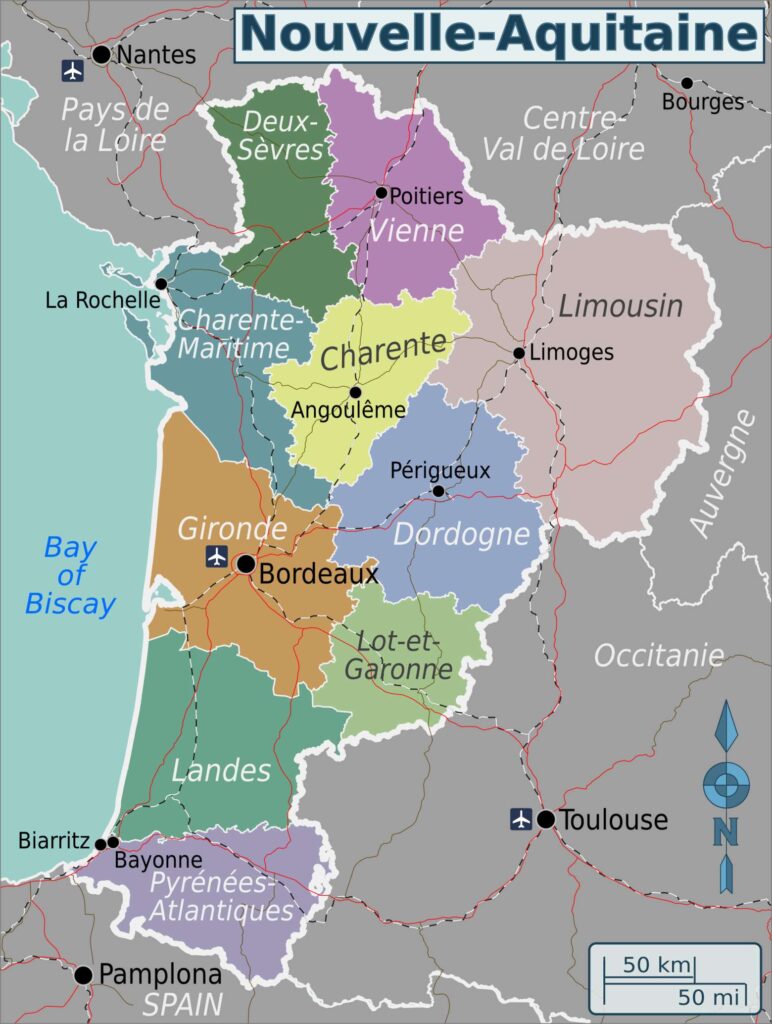
Shaundd, CC BY-SA 4.0, via Wikimedia Commons
NOUVELLE-AQUITAINE OVERVIEW & CHARACTER
Nouvelle-Aquitaine is the largest administrative region in France — and probably the least understood by American expats who haven't spent time here. It's easy to reduce it to "Bordeaux and wine," but that misses most of the story. This is a region of Atlantic coast, Pyrenean foothills, medieval bastide towns, duck farms, surf culture, prehistoric caves, and a quality of rural life that has drawn English-speaking settlers for decades.
The region stretches from the Loire Valley in the north to the Spanish border in the south, from the Atlantic coast east to the Massif Central foothills. The experience of living in Nouvelle-Aquitaine varies enormously depending on which corner you choose — from cosmopolitan Bordeaux to the deeply rural Creuse, from the surf breaks of Hossegor to the truffle markets of Périgueux.
Bordeaux has modernised dramatically over the past fifteen years — the tram network, the waterfront renovation, the food scene — and is now genuinely one of France's most liveable cities. But drive 45 minutes in almost any direction and you're in countryside that operates at a different tempo entirely.
The Dordogne is the classic English-speaking expat heartland of France. It has been for 40 years. There's a reason: the landscape is exceptional, the property affordable, the food genuinely extraordinary, and the pace of life achievable. Bergerac airport with its Ryanair link to London Stansted made it uniquely accessible to British buyers. American expats are a smaller but growing community, particularly around Sarlat and Périgueux.
Biarritz and the Basque Country bring something entirely different — urban energy, Atlantic surf culture, a fierce regional identity that is neither fully French nor Spanish. The food here is arguably the best in France. Property is expensive and getting more so, but the lifestyle is extraordinary.
For US expats, Nouvelle-Aquitaine offers a combination that's genuine and underrated: world-class food and wine, serious value outside the premium cities, improving Atlantic connectivity, and a pace of rural life that is quite simply unavailable at comparable cost anywhere else in Western Europe.
Departments at a Glance
Nouvelle-Aquitaine's 12 departments split naturally into three zones, each with its own character and expat profile.
The Atlantic Coast & Basque Country
- Gironde (33): Bordeaux and its wine appellations — the Médoc, Saint-Émilion, Arcachon Bay. The most urban department. Bordeaux city is world-class and increasingly expensive; the Entre-Deux-Mers countryside offers better value. Strong expat community, excellent infrastructure.
- Pyrénées-Atlantiques (64): Biarritz, Bayonne, Pau, and the French Basque Country. Two distinct cultures — Basque coast and Béarn inland. Biarritz is one of France's most desirable addresses; Pau is significantly more affordable and often overlooked by expats.
- Landes (40): The vast pine forest, Atlantic surf beaches (Hossegor, Capbreton), and a beautifully uncrowded coastline. Inexpensive outside the surf towns. A car is essential — limited public transport.
The Périgord / Dordogne Heartland
- Dordogne (24): The English-speaking expat heartland of France. Sarlat, Périgueux, Bergerac, the Vézère valley caves. Property is affordable and plentiful. Bergerac airport (Ryanair to London Stansted) is the key access point for British expats. Stunning landscape, world-class food, genuinely rural.
- Lot-et-Garonne (47): Agen, Nérac, Villeneuve-sur-Lot. Rolling farmland, plum orchards, bastide villages. Underrated and underpriced. Good access to both Bordeaux and Toulouse. Popular with Dutch and Belgian expats as well as British.
- Charente (16): Cognac. Angoulême. The Charente River. Calm, deeply French, affordable, and significantly underexplored by US expats. TGV to Paris in 2h. Angoulême hosts Europe's largest comics festival annually.
Poitou, Limousin & the Northern Coast
- Charente-Maritime (17): La Rochelle, Rochefort, the Île de Ré. Excellent sailing, good beaches, strong British community. La Rochelle is one of France's most attractive port cities and increasingly popular with remote workers.
- Vienne (86): Poitiers and the Vienne valley. Exceptional TGV access (1h25 from Paris). Rural countryside that hasn't been discovered by expats yet — prices are low and the France on offer is genuinely authentic.
- Haute-Vienne (87): Limoges — world famous for porcelain, less famous for being a quietly pleasant city with very reasonable property. One of France's best-value departments.
- Deux-Sèvres (79), Corrèze (19), Creuse (23): France at its most rural and most affordable. The Creuse in particular has seen a wave of British rural settlers attracted by prices that have no equivalent in England.
Transport is Nouvelle-Aquitaine's most interesting variable. Bordeaux is extraordinarily well connected. The rural departments are not. Understanding which part of the region you're considering is essential before assessing transport.
AIRPORTS
- Bordeaux-Mérignac (BOD) — The region's gateway. There is no nonstop service to the United States — Montréal (Air Transat) is the only North American route. Year-round international: London Heathrow and Gatwick, Amsterdam, Dublin, Frankfurt, Madrid, Lisbon, Istanbul. A well-connected airport that punches above its size.
- Biarritz Pays Basque (BIQ) — Strong UK connections: London Gatwick, Stansted, Birmingham, Manchester, Bristol, Dublin (Ryanair and easyJet). Useful for British expats in the Basque Country and Landes. No USA service.
- Bergerac Dordogne Périgord (EGC) — Ryanair to London Stansted plus seasonal UK regional routes. The reason British expat density in the Dordogne is so high — Ryanair made the Périgord accessible from the UK for a fraction of the cost. No USA service; US expats route via Bordeaux or Paris.
- La Rochelle (LRH) & Pau-Pyrénées (PUF) — La Rochelle: Ryanair to London Stansted, Dublin, and European routes — useful for Charente-Maritime. Pau: UK connections and some Spanish routes — fills a gap for the Béarn/lower Pyrénées area.
Honest assessment on USA flights: no airport in Nouvelle-Aquitaine flies nonstop to the United States. Factor Paris CDG as your de facto hub — Bordeaux is 2h05 from Paris Montparnasse by TGV, with a cross-Paris transfer to CDG on top. Bordeaux is excellent for Europe, not for transatlantic travel.
TGV & TRAIN
- Bordeaux → Paris Montparnasse — 2h05. Frequent TGV service — roughly every hour. One of France's best provincial-to-Paris connections, transformed by the LGV Sud Europe Atlantique (opened 2017).
- Poitiers → Paris Montparnasse — 1h25. Exceptional — Paris feels like a day-trip destination from northern Vienne.
- Angoulême → Paris Montparnasse — 2h00. Good TGV frequency. Charente is more accessible than its rural character suggests.
- La Rochelle → Paris Montparnasse — 2h45. A branch off the main Bordeaux line.
- Bayonne → Paris Montparnasse — 3h50. The line continues south to the Basque Country.
- Périgueux / Bergerac — No direct TGV. Change at Bordeaux. Driving or flying via EGC is often more practical for the Dordogne.
Most of Nouvelle-Aquitaine outside Bordeaux city requires a car. The Dordogne in particular is very car-dependent — budget for one from day one.
The Atlantic climate is Nouvelle-Aquitaine's defining characteristic — and the most important thing to honestly assess before committing to this region over the Mediterranean alternatives. It is not warm all year round. Winters are grey, damp, and often overcast for weeks at a time. This is not Montpellier in January, where the sun shines at 12°C and you eat lunch outside.
Spring (March–May)
Variable and beautiful. The countryside comes alive green — this is when the Dordogne looks like a film set. Temperatures warm gradually from 12°C in March to 22°C by late May. Some rain, but increasingly pleasant by April.
Average high: 13–22°C (55–72°F)
Summer (June–September)
Warm and generally sunny without Mediterranean extremes. Bordeaux regularly hits 30–33°C in July–August; the Basque coast is cooler (25–27°C) with Atlantic breezes. The 2019 and 2022 heat waves pushed Bordeaux above 40°C — increasingly a reality. Generally though, summer in Nouvelle-Aquitaine is easier than in Occitanie for those who find extreme heat difficult.
Average high: 25–33°C (77–91°F)
Autumn (October–November)
The vendange brings harvest activity to the vineyards. October is often the most beautiful month — golden light, cooling temperatures. November turns grey and wet relatively quickly.
Average high: 19–24°C October, dropping to 13°C by November
Winter (December–February)
Mild but genuinely overcast. Frost is rare on the coast and in Bordeaux; inland departments (Corrèze, Creuse, Haute-Vienne) get colder and snowier than you might expect. Bordeaux typically sees 50–70 days of rainfall in winter months. If you came from the Pacific Northwest, this won't surprise you. If you expected year-round sun in the southwest of France, it will.
Average low: 4–8°C (39–46°F) coast; colder inland
Nouvelle-Aquitaine is one of France's best-value regions — with a significant caveat: Bordeaux city is increasingly expensive and should be evaluated separately from the rest of the region.
MONTHLY BUDGET ESTIMATES
Realistic 2025–2026 figures for established expats:
| CATEGORY | SINGLE (modest) | COUPLE (comfortable) | FAMILY OF 4 |
| Rent / mortgage | €550–850 | €850–1,300 | €1,100–1,800 |
| Groceries | €180–260 | €320–450 | €500–700 |
| Utilities (elec, gas, water) | €90–130 | €130–200 | €180–280 |
| Healthcare (mutuelle top-up) | €60–90 | €120–180 | €200–350 |
| Transport (car recommended) | €150–220 | €220–320 | €280–400 |
| Dining out / café | €100–180 | €180–350 | €220–380 |
| Miscellaneous / leisure | €150–250 | €250–400 | €300–500 |
| TOTAL (approx) | €1,280–1,980 | €2,070–3,200 | €2,780–4,410 |
Note on car costs: Rural Nouvelle-Aquitaine requires a car for most day-to-day life — this is a structural cost that doesn't exist for city-based expats in Montpellier or Lyon. Monthly car costs (insurance, fuel, maintenance) are factored into the transport line above.
HOW DOES THIS COMPARE TO THE US?
A couple living comfortably in Nouvelle-Aquitaine on €2,500–3,000/month would need roughly $4,500–6,500/month for an equivalent lifestyle in most major US cities. Rural Dordogne in particular offers a quality of space, food, and pace of life that would cost $8,000–12,000/month in equivalent US small-city settings — if it existed at all, which in most cases it doesn't.
Property in Nouvelle-Aquitaine is the great value story of French expat real estate — with important zones of exception.
Price Ranges by Area (2025–2026)
Bordeaux city centre: €4,500–€7,000/m²
Bordeaux suburbs (Mérignac, Pessac, Talence): €3,000–€4,500/m²
Biarritz: €5,000–€9,000/m² — extremely sought-after, prices have surged significantly
Bayonne / Anglet: €3,500–€5,500/m²
La Rochelle city: €3,000–€4,500/m²
Périgueux: €1,200–€2,500/m²
Dordogne (rural / villages): €800–€2,000/m²
Bergerac area: €1,000–€2,200/m²
Charente (rural): €700–€1,600/m²
Lot-et-Garonne: €900–€2,000/m²
Creuse / Corrèze: €500–€1,200/m² — some of the lowest prices in France
WHAT THIS MEANS IN PRACTICE
In 2026, €350,000 gets you a very different property depending on where in Nouvelle-Aquitaine you look:
Bordeaux city: a 2-bedroom apartment in a good neighbourhood, or a small house in an outer suburb
Périgueux area: a 4-bedroom house with garden in a village within 20 minutes of the city
Rural Dordogne: a stone farmhouse with several acres, pool possible, needing some renovation
Charente / Creuse: a renovated 5-bedroom farmhouse with land, barn, and views. Turn-key.
THE DORDOGNE RENOVATION MARKET
A significant segment of the Dordogne expat story involves buying properties requiring renovation. The supply of stone farmhouses, manoirs, and bastide houses needing work is substantial — prices can be remarkable, but renovation costs in France should not be underestimated. Local artisans are good but not cheap, and VAT (20%) applies. Budget generously and always get three quotes.
THE BUYING PROCESS: KEY POINTS FOR US BUYERS
All French property sales go through a Notaire — a state-appointed official. Notaire fees (frais de notaire): 7–8% of the purchase price for existing properties. Taxe foncière (annual property tax): typically €500–3,000 depending on property and location. US citizens face additional FATCA reporting requirements on French bank accounts and mortgages — use a US expat tax specialist before proceeding.
Nouvelle-Aquitaine has solid healthcare infrastructure concentrated around its major cities. Coverage is generally good throughout the region, though rural departments have genuine limitations.
MAJOR HOSPITALS
CHU de Bordeaux — One of France's largest university hospital complexes, spread across multiple sites (Haut-Lévêque for cardiology, Pellegrin main campus, Saint-André). Excellent across specialities — cardiology, oncology, neurology, transplant. For expats within an hour's drive, the level of care is genuinely world-class.
Regional Hospitals — Centre Hospitalier de Périgueux: well-equipped for the Dordogne. CH de La Rochelle: covers Charente-Maritime. CH de Bayonne (CH de la Côte Basque): serves the Basque Country well. For complex or specialised care, referral to Bordeaux CHU is common and the system handles this efficiently.
For rural departments (Creuse, Corrèze), GP availability is the most significant practical limitation. France's déserts médicaux are a real issue in remote departments. If you have significant ongoing healthcare needs, factor proximity to a major hospital into your location decision.
HOW THE FRENCH HEALTH SYSTEM WORKS FOR EXPATS
PUMA: After 3 months of legal residency, you can apply for France's universal health coverage, covering approximately 70% of most healthcare costs.
Mutuelle: A top-up private insurance covering the remaining 30%. Typically €60–90/month per person, rising with age and the level of cover.
Carte Vitale: Your health insurance card — present it at every medical appointment.
Gap period: For the first 3 months, you need private international health insurance. Allianz Care, April International, and Cigna Global are popular with US expats. Expect €200–500/month during this period.
For families moving with children, schooling options in Nouvelle-Aquitaine are reasonable in the major cities and more limited in rural areas.
INTERNATIONAL & BILINGUAL SCHOOLS
International School of Bordeaux — The main English-medium option in the Bordeaux metropolitan area. IB curriculum, genuine international student body. Located in Gradignan, southwest of Bordeaux. Well-regarded and the obvious first choice for English-speaking expat families arriving in Bordeaux.
Cité Scolaire Internationale de Bordeaux-Talence — Public school with international sections (English, Spanish, German, Portuguese). Competitive entry, excellent reputation. Free (public school) — a very good option for families who want bilingual education without international school fees.
RURAL SCHOOLING
For rural Dordogne and Charente families: the reality is French public school. The French primary system is strong, and young children adapt to French immersion remarkably quickly — typically conversationally fluent within 6–9 months. For secondary age children, the nearest English-medium options are in Bordeaux (1–2 hours from much of the Dordogne).
Nouvelle-Aquitaine has the highest concentration of British expats of any region in France — the Dordogne in particular has been a major destination since the 1980s. American expats are less prevalent historically, but the community is growing, particularly in Bordeaux, the Basque Country, and among remote workers seeking rural France.
WHO'S HERE
The Dordogne: predominantly British, significant Dutch and Belgian presence, growing American rural lifestyle seekers. A community old enough to have its own shops, churches, medical services, and social infrastructure.
Bordeaux: genuinely international — large Portuguese community (historical), British professionals, growing American tech and remote-work arrivals.
Biarritz / Basque Country: mixed European and American surf-culture arrivals, younger demographic.
Charente-Maritime / La Rochelle: strong British sailing community, noticeable international population relative to city size.
INTEGRATION
The Dordogne expat community is large enough and established enough that you can live comfortably in English indefinitely — which is both a comfort and a trap. Our honest advice: learn French. The life available to you in French is incomparably richer. The markets, the wine tastings, the village fêtes, the neighbours — they're all better in French.
EXPAT GROUPS & RESOURCES
Accueil des Villes Françaises (AVF) — branches in Bordeaux, Périgueux, La Rochelle, and most major towns
American Club of Bordeaux — active social community for US expats in the Bordeaux area
InterNations Bordeaux — regular networking events
Dordogne-specific Facebook groups: 'Expats in Dordogne', 'English speakers in the Périgord' — established and active
Alliance Française — language and cultural integration in all major cities
VISA & ADMINISTRATIVE NOTES
France has specific visa pathways for Americans looking to make a long-term move. The most common for Nouvelle-Aquitaine-bound expats:
- Visa de Long Séjour Visiteur (VLS-Visiteur): The standard 'non-working' visa for those with sufficient income/savings. Requires proof of financial means (~€1,500/month per person minimum), health insurance, and accommodation. Applied for at the French Consulate in the US before departure.
- Visa Talent — Passeport Talent: For entrepreneurs, investors, artists, scientists, and certain professionals. If you're bringing a business or substantial investment, this pathway is worth exploring.
- Visa Retraité: For those receiving pension income — requires same financial means proof as VLS-Visiteur.
- ANEF — most residence permit applications, renewals and status tracking are now filed online through the Administration Numérique pour les Étrangers en France: administration-etrangers-en-france.interieur.gouv.fr. Your préfecture still handles appointments, document checks and collecting your card.
- Préfecture de la Gironde (Bordeaux) for dept 33 — gironde.gouv.fr
- Préfecture de la Dordogne (Périgueux) for dept 24 — dordogne.gouv.fr
- Préfecture des Pyrénées-Atlantiques (Pau) for dept 64 — pyrenees-atlantiques.gouv.fr
- OFII registration (mandatory medical exam + integration contract) within ~3 months of arrival.
Nouvelle-Aquitaine Region — Useful Links
🏛 Official & Government
- nouvelle-aquitaine.fr — Région Nouvelle-Aquitaine official regional government website
- gironde.gouv.fr — Préfecture de la Gironde (Bordeaux, dept 33) — carte de séjour, residency admin
- dordogne.gouv.fr — Préfecture de la Dordogne (Périgueux, dept 24)
- pyrenees-atlantiques.gouv.fr — Préfecture des Pyrénées-Atlantiques (Pau, dept 64)
- charente-maritime.gouv.fr — Préfecture de la Charente-Maritime (La Rochelle, dept 17)
- landes.gouv.fr — Préfecture des Landes (Mont-de-Marsan, dept 40)
- lot-et-garonne.gouv.fr — Préfecture du Lot-et-Garonne (Agen, dept 47)
- nouvelle-aquitaine.ars.sante.fr — ARS Nouvelle-Aquitaine — regional health agency and alerts
🏥 Healthcare
- chu-bordeaux.fr — CHU de Bordeaux — one of France's largest teaching hospital complexes
- chu-poitiers.fr — CHU de Poitiers (Vienne, dept 86)
- ch-perigueux.fr — Centre Hospitalier de Périgueux (Dordogne)
- ch-bayonne.fr — CH de la Côte Basque (Bayonne / Biarritz)
- chu-limoges.fr — CHU de Limoges
✈️ Transport
- bordeaux.aeroport.fr — Bordeaux–Mérignac Airport (BOD)
- biarritz.aeroport.fr — Biarritz Pays Basque Airport (BIQ)
- bergerac.aeroport.fr — Bergerac Dordogne Périgord Airport (EGC) — London Stansted via Ryanair
- infotbm.com — TBM — Bordeaux tram, bus and Vélo bike share network
- transports.nouvelle-aquitaine.fr — Regional transport — buses and TER trains across the region
- ter.sncf.com/nouvelle-aquitaine — TER Nouvelle-Aquitaine — regional trains and fares
- pau.aeroport.fr — Pau-Pyrénées Airport (PUF)
- larochelle.aeroport.fr — La Rochelle-Île de Ré Airport (LRH) — popular with UK visitors
🛫 Airlines from Regional Hubs
- Bordeaux-Mérignac (BOD) (airport site) — Air France, Transavia, easyJet, Ryanair, Volotea, Vueling, British Airways, KLM, Lufthansa, Iberia, Aer Lingus (routes and seasons change — check the airport site)
- Biarritz (BIQ) (airport site) — Air France, Ryanair, easyJet, Volotea, Transavia (routes and seasons change — check the airport site)
- Bergerac (EGC) (airport site) — Ryanair, Jet2 — mainly UK routes
- Pau-Pyrénées (PUF) (airport site) — Air France, Transavia, Ryanair (routes and seasons change — check the airport site)
- La Rochelle (LRH) (airport site) — Ryanair, easyJet — mainly UK routes
👥 Expat Resources
- internations.org/bordeaux-expats — InterNations Bordeaux — expat networking events
- perigordexpats.com — Périgord Expats — established English-speaking community in the Dordogne
🍷 Wine & Local Life
- bordeaux.com — Official Bordeaux wines portal — châteaux, appellations, visits, events calendar
- dordogne-perigord-tourisme.fr — Dordogne Périgord tourism — villages, markets, activities
- tourisme-biarritz.fr — Biarritz tourism — surf, Basque culture, events calendar
- sarlat-tourisme.com — Sarlat tourist office — gateway to the Périgord Noir
- u-bordeaux.fr — Université de Bordeaux — courses and international programmes
💶 Banking & Money Transfers
- ca-aquitaine.fr — Crédit Agricole Aquitaine — main regional bank, English-speaking staff in larger branches

Our Take
We should be upfront about something: we don't live in Nouvelle-Aquitaine — our home is in Occitanie. So we come to this region as visitors and observers rather than residents. But we've spent meaningful time here over the years, particularly in the Basque Country and the Gironde, and the Dordogne is a region we understand well from the outside.
What we genuinely admire: The quality of the food and wine landscape is arguably unmatched anywhere in France. Bordeaux has reinvented itself and is now a genuinely great city to live in — the waterfront, the tram network, the wine bars. The Dordogne at its best — spring mornings in the Vézère valley, a Tuesday market in Sarlat — is simply one of the most beautiful places in France. The coast from Arcachon to Biarritz is extraordinary. And the value in the rural interior is real and significant.
Our honest caveats: The Atlantic climate requires honest self-assessment. If you came to France for the sun — specifically, winter sun — Nouvelle-Aquitaine will disappoint. The Dordogne expat community, while warm and established, can become a comfort zone that insulates you from French life. The most interesting expats we've met in the region are the ones who resisted that cocoon and learned the language and the local culture properly. And the rural departments that offer extraordinary value also require extraordinary independence — long drives to services, limited public transport, sometimes limited broadband. These are manageable but real.
Who we'd recommend Nouvelle-Aquitaine to: Remote workers or retirees drawn to Atlantic landscape rather than Mediterranean heat. Families who want a large, restorable rural property at a price that's simply impossible elsewhere in Western Europe. Bordeaux and food-culture enthusiasts. Anyone whose France is Périgord truffles, Basque pintxos, and Médoc wine rather than rosé on a Mediterranean terrace. It's a wonderful region — just a different France than the south.
Practical first step: Before committing to rural Dordogne, spend at least one winter month there — not a summer visit. The difference between July in the Périgord and February is the difference between a holiday and a life. Most people who chose wisely did exactly this. Most who had regrets skipped this step.
Our Rating: ★★★★☆
Four stars because we genuinely admire what Nouvelle-Aquitaine offers — and because anyone who gets it right here gets it very right. We'd move here if we wanted Atlantic France, wine country, and rural space. The fifth star stays with our Mediterranean home, but only just.
We work with Leggett Immobilier
An English-speaking agency with listings across France, and the one we point our own readers to. If you’d like an introduction, or a property consultation alongside your relocation planning, get in touch.
We can also connect you with English-speaking mortgage brokers. French mortgage rates have often run below US rates, so paying cash isn’t automatically the better move — worth running the numbers before you decide.
