
Living in Bourgogne-Franche-Comté
Living in Bourgogne-Franche-Comté - Paris in 1h35, at Half the Price
Grand cru vineyards, Jura mountains, and Dijon's old town. Real winters and no coastline, but the best TGV link in this guide. A complete guide for US expats.
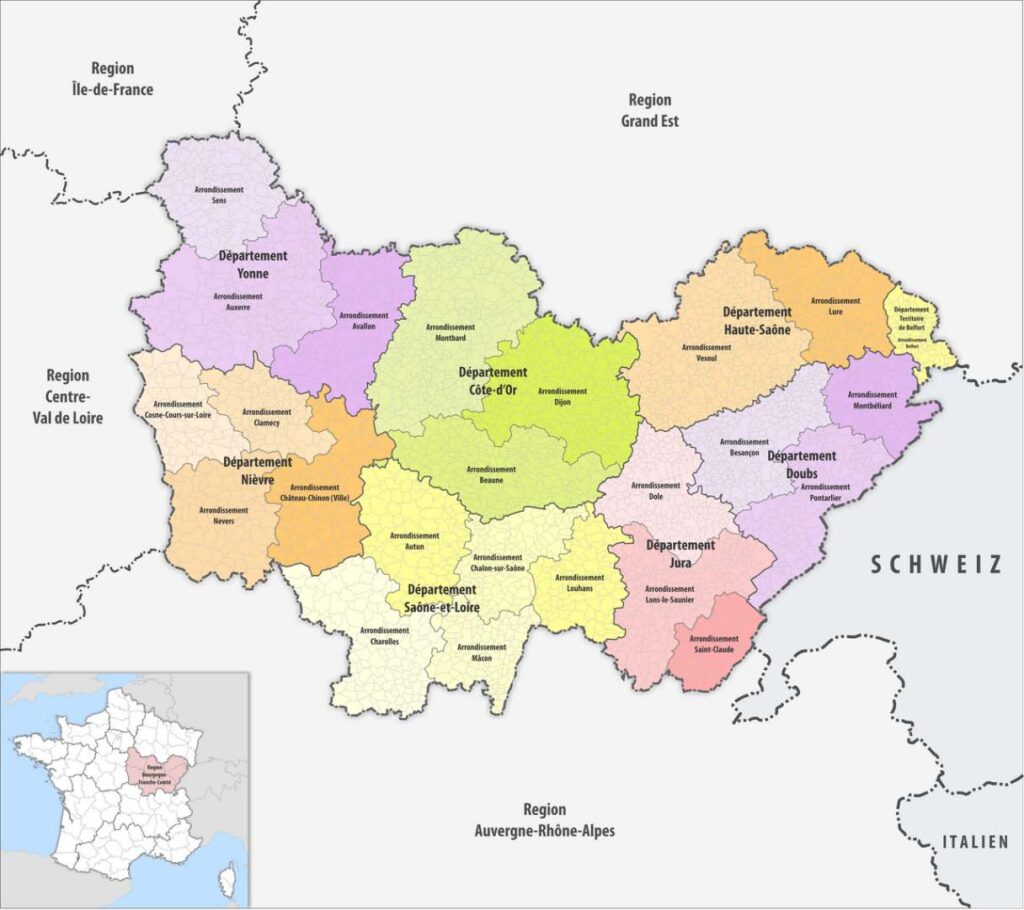
Tschubby, CC BY-SA 3.0, via Wikimedia Commons
BOURGOGNE-FRANCHE-COMTÉ OVERVIEW & CHARACTER
 Bourgogne-Franche-Comté is the sleeping giant of French expat destinations — a region that rarely appears on the shortlist but consistently delights those who end up here. It's not the Mediterranean. It doesn't have the instant glamour of the Côte d'Azur or the rugged drama of the Alps. What it has is something quieter and arguably more sustainable: world-class wine, extraordinary food culture, a TGV that gets you to Paris in 1h35, property prices that feel like a different France, and a landscape of rolling hills, river valleys, and medieval villages that becomes more beautiful the longer you live in it.
Dijon is the capital — and it's better than its reputation. A proper medium-sized French city (160,000 inhabitants) with a magnificent medieval centre, outstanding museums, a university, a thriving market, and the unmistakeable pride of a city that knows it's the gateway to one of the world's great wine regions. Beaune, 45 minutes south, is the wine capital — compact, beautiful, deeply touristy in summer, more itself in winter.
The Côte d'Or wine road — Gevrey-Chambertin, Nuits-Saint-Georges, Vosne-Romanée, Pommard, Meursault — is a UNESCO World Heritage landscape. Driving it on a November morning in the mist, with the vines turning gold, is one of France's genuinely great experiences.
For US expats, Bourgogne-Franche-Comté offers a particular combination: the fastest TGV to Paris of any regional city in France (1h35 from Dijon), property prices that make the Mediterranean regions look expensive, a food and wine culture of international importance, and a pace of life that rewards those who came for France itself rather than specifically for the climate.
Departments at a Glance
The region's 8 departments cover classic Burgundy wine country, the Franche-Comté highlands bordering Switzerland, and some of France's most affordable rural landscapes.
Classic Burgundy (Wine Country)
- Côte-d'Or (21): Dijon and the great wine road. The premium department — Dijon property commands the region's highest prices. The Côte d'Or vineyard corridor (Gevrey-Chambertin to Santenay) is UNESCO-listed. The most popular department for incoming expats who want Burgundy with city access.
- Saône-et-Loire (71): Mâcon, Chalon-sur-Saône, Cluny, Tournus. The southern extension of Burgundy wine country — Pouilly-Fuissé, Mâcon blanc, Mercurey. More rural than Côte-d'Or, lower prices, beautiful Romanesque architecture. Good access to Lyon (1h30 by road). Often overlooked, frequently loved.
- Yonne (89): Auxerre, Vézelay, Chablis. The northern entry point to Burgundy — closest to Paris (Auxerre is just over an hour by train). Chablis country. Vézelay is one of France's great Romanesque art sites. Property here is excellent value for the Paris accessibility it offers.
- Nièvre (58): Nevers and the Morvan natural park. The most rural and affordable of Burgundy's departments. The Morvan is wild upland country — lakes, forests, cattle farms. Genuinely remote in places. For those seeking deep rural France at prices that are almost impossible to find elsewhere in Western Europe.
Franche-Comté (Highlands & Switzerland Border)
- Doubs (25): Besançon and the Franche-Comté. Besançon is an underrated gem — a circular city wrapped by the Doubs river, with a Vauban citadel on the hill above it. Good university town, reasonable prices, 30 minutes from Switzerland. Comté cheese country.
- Jura (39): The Jura plateau and its lakes. Jura wine country — distinctive Savagnin grape, vin jaune, crémant. More affordable than Burgundy proper. Excellent hiking and cross-country skiing. Switzerland accessible. A quiet, deeply pleasant landscape.
- Haute-Saône (70) & Territoire de Belfort (90): The eastern border territory. Less well-known, quietly liveable. Besançon's influence extends into Haute-Saône. Belfort is a historic fortified city close to both Switzerland and Alsace.
Bourgogne's transport story is dominated by one extraordinary fact: Dijon is 1h35 from Paris Gare de Lyon by TGV — the same travel time as some Paris suburbs. For expats who travel to Paris regularly, this is a genuine game-changer that reshapes the region's appeal entirely.
TGV & TRAIN
- Dijon → Paris Gare de Lyon — 1h35. Multiple TGV departures daily. This is the region's star asset. Paris feels like a day trip — because it is.
- Beaune → Paris Gare de Lyon — ~1h40. Some direct TGVs; others change at Dijon. The wine capital, 45 minutes south of Dijon.
- Mâcon → Paris Gare de Lyon — 1h45. On the main TGV Paris–Lyon line with excellent frequency.
- Auxerre → Paris Gare de Bercy — ~1h15. Intercity rather than TGV, but fast. Burgundy's closest major town to Paris.
- Besançon → Paris Gare de Lyon — ~2h10. TGV via the Besançon Franche-Comté TGV station (outside town centre).
AIRPORTS
- Dijon Airport (DIJ) — Very limited service — Air France to Paris Orly essentially only. Not a practical international hub. In practice, expats in Bourgogne use Lyon Saint-Exupéry (LYS) for international travel — 1h30 to 2h by road from Dijon. This is the region's main practical limitation for frequent international travellers.
- Lyon Saint-Exupéry (LYS) — The de facto international hub for Bourgogne expats willing to make the 1h30 drive or train journey. Wide European network plus Montréal (Air Canada, Air Transat), Dubai (Emirates) and Addis Ababa (Ethiopian) — but no nonstop service to the United States.
Honest assessment: for flights to the United States, Paris CDG is your hub — and Bourgogne is unusually well placed for it, with Dijon just 1h35 from Paris Gare de Lyon. Lyon Saint-Exupéry is the better choice for Europe, Montréal and the Middle East.
LOCAL TRANSPORT
Dijon has a solid tram and bus network (Divia) covering the city and surrounding communes. For most of Bourgogne-Franche-Comté outside Dijon, Besançon, and Mâcon, a car is essential. The region is rural and the distances between services, markets, and towns require independent transport.
Continental, honest, and four-season. Burgundy winters are genuinely cold — average lows of 0–3°C in January, with frost common and occasional snow. Summers are warm and often beautiful: 24–28°C average, with some July–August peaks above 32°C. The autumn — the vendange season — is the great gift: September golden, October amber, the vineyards turning colour along the Côte d'Or in one of France's most celebrated annual spectacles.
Spring (March–May)
Burgundy spring is genuine — blossom on the vines, warming temperatures, and the quiet before the tourist season. By April, the wine road is one of the most beautiful places in France. Average high: 11–19°C (52–66°F).
Summer (June–September)
Warm and increasingly hot — 24–28°C is typical, but July–August regularly exceeds 32°C and occasionally 38°C. No sea breeze, no tramontane — just still, warm continental heat. Generally manageable, and evenings cool quickly.
Average high: 24–30°C (75–86°F)
Autumn (October–November)
The great season. The vendange in September–October fills the landscape with tractors, harvest activity, and the smell of fermentation. The Côte d'Or vines turn gold and red in a display that draws visitors from across France. November brings rain and cooling.
Average high: 17–20°C October, dropping to 10°C by November
Winter (December–February)
Cold and honest. Frost is common — average lows of 0–3°C, with some nights reaching −5°C. Snow falls most winters in Dijon, more heavily inland. This is not the weather to come to France to escape the cold — it won't work. But for those who embrace it: log fires, cassoulet, Burgundy red, and the knowledge that spring will arrive and will be extraordinary.
Average low: 0–3°C (32–37°F) · Occasional −5°C cold spells
Bourgogne-Franche-Comté offers some of the best value in France for the level of cultural richness, infrastructure, and TGV access on offer. Dijon is notably affordable for a city of its quality — a genuine anomaly in French urban pricing.
MONTHLY BUDGET ESTIMATES
Realistic 2025–2026 figures for established expats (Dijon basis):
| CATEGORY | SINGLE (modest) | COUPLE (comfortable) | FAMILY OF 4 |
| Rent / mortgage | €450–700 | €700–1,100 | €950–1,600 |
| Groceries | €170–240 | €300–430 | €480–660 |
| Utilities | €90–140 | €130–200 | €180–280 |
| Healthcare (mutuelle) | €60–90 | €120–180 | €200–350 |
| Transport | €60–120 | €120–200 | €180–300 |
| Dining out / café | €100–180 | €180–320 | €240–400 |
| Miscellaneous / leisure | €130–220 | €220–360 | €280–460 |
| TOTAL (approx) | €1,060–1,690 | €1,770–2,790 | €2,510–4,050 |
Note: Outside Dijon, costs in rural Bourgogne fall further — the Nièvre and Jura in particular offer cost-of-living that is among the lowest in France for any area with reasonable services. Budget for a car in almost all rural settings.
HOW DOES THIS COMPARE TO THE US?
A couple living well in Dijon on €2,000–2,500/month — with good food, regular wine, and occasional Paris day trips — would need roughly $4,000–6,000/month to replicate that lifestyle in most US cities. In college towns and mid-sized US cities with comparable amenity to Dijon (university, museums, good restaurants), the comparison is even more stark. Dijon punches well above its cost.
Burgundy offers some of the best property value in France for the level of cultural richness, infrastructure, and TGV access on offer.
Price Ranges by Area (2025–2026)
Dijon city centre: €2,500–€4,000/m²
Dijon established residential: €2,000–€3,200/m²
Beaune: €2,500–€4,500/m² (Beaune premium — desirable and compact)
Côte d'Or wine villages (Gevrey-Chambertin, Nuits-Saint-Georges): €2,000–€4,000/m²
Mâcon: €1,600–€2,800/m²
Auxerre: €1,400–€2,500/m²
Nièvre / Morvan (rural): €500–€1,200/m² — among France's lowest
Besançon: €1,800–€3,000/m²
Jura (rural): €900–€1,800/m²
WHAT THIS MEANS IN PRACTICE
In 2026, €350,000 gets you:
Dijon city centre: a generous 3-bedroom apartment in a belle époque building
Beaune: a 3-bedroom house with garden within walking distance of the old town
Côte d'Or wine village: a 4-bedroom village house with cellar and courtyard
Nièvre / Morvan rural: a restored farmhouse with land, outbuildings, and privacy. Genuinely extraordinary value.
THE BUYING PROCESS: KEY POINTS FOR US BUYERS
All French property sales go through a Notaire — a state-appointed official. Notaire fees: 7–8% of the purchase price for existing properties. Taxe foncière (annual property tax): typically €500–2,500 depending on property and location (lower than the coastal regions). US citizens face additional FATCA reporting requirements on French bank accounts — use a US expat tax specialist before proceeding.
Bourgogne-Franche-Comté has solid healthcare infrastructure centred on Dijon and Besançon.
MAJOR HOSPITALS
CHU de Dijon — The main teaching hospital for the region. Excellent cardiology, oncology, and general medicine. Well-staffed for a medium-sized city. For complex specialist care, TGV to Paris (1h35) or Lyon (1h30 drive) is the practical option — and both are genuinely accessible.
CHU de Besançon — Serves Doubs and the Franche-Comté. Good general hospital with strong ties to the University of Franche-Comté medical school. Besançon's proximity to Switzerland means some residents also access Swiss healthcare options.
Centre Hospitalier de Mâcon — Serves Saône-et-Loire in the southern part of the region. For serious conditions, Lyon CHU is 1h30 by road.
RURAL HEALTHCARE NOTE
For the most rural departments (Nièvre, Morvan), GP availability is the most significant practical limitation. France's déserts médicaux (medical deserts) are a real issue in remote areas. If you have significant ongoing healthcare needs, factor proximity to Dijon or another hospital centre into your location decision. This is not a reason to avoid rural Burgundy, but it is a reason to plan carefully.
HOW THE FRENCH HEALTH SYSTEM WORKS FOR EXPATS
PUMA: After 3 months of legal residency, you can apply for France's universal health coverage, covering approximately 70% of most healthcare costs.
Mutuelle: A top-up private insurance covering the remaining 30%. Typically €60–90/month per person, rising with age and the level of cover.
Carte Vitale: Your health insurance card — present it at every medical appointment.
Gap period: For the first 3 months, you need private international health insurance. Allianz Care, April International, and Cigna Global are the most commonly used providers by US expats. Expect €200–500/month during this period.
Bourgogne-Franche-Comté does not have dedicated English-medium international schools — this is a genuine distinction from Lyon or Bordeaux and worth knowing in advance.
SCHOOLING OPTIONS
French Public School — The standard and generally excellent option. The French primary system is strong, and young children adapt to French immersion remarkably quickly — typically conversationally fluent within 6–9 months. For secondary-age children needing an English-medium environment, the nearest options are in Lyon (1h30 by road) or Paris (1h35 by TGV). Both are viable as boarding options for families settled in the region.
CNED (Centre National d'Enseignement à Distance) — French state-supervised homeschooling. Used by some expat families in very rural settings, and legally valid in France.
Université de Bourgogne (Dijon) — For families with college-age children considering French higher education. One of France's historic universities with some English-taught programmes at postgraduate level. Dijon has a genuine student culture that keeps the city young and vibrant.
Bourgogne-Franche-Comté has a smaller and less organised expat community than the Mediterranean regions or the Dordogne — which is, for many who choose it, precisely the point. The expats who end up here tend to be more integrated into French life, more committed to learning the language, and more interested in Burgundian culture on its own terms.
WHO'S HERE
The wine trade brings international connections — many négociants, domaine owners, and wine buyers in the Côte d'Or corridor are non-French. British, American, and Japanese buyers and settlers are not uncommon around Beaune and Nuits-Saint-Georges.
Dijon: a growing professional and academic community, younger demographic, genuinely integrated
Rural Burgundy: a quieter, more self-sufficient expat presence — those who specifically sought France rather than an expat bubble
INTEGRATION
Bourgogne is one of the regions where integration with French life is most naturally encouraged — simply because there isn't an English-speaking bubble to retreat into. This is a feature, not a bug. The expats who thrive here tend to be those who wanted the full French experience: the language, the neighbours, the market, the culture. Learning French here is not optional in the way it might feel in the Dordogne — it's the price of admission to a very good life.
EXPAT GROUPS & RESOURCES
Accueil des Villes Françaises (AVF) — branches in Dijon, Beaune, Mâcon, and Besançon
Facebook groups: 'Expats in Burgundy', 'Living in Dijon', 'British in Burgundy' — active communities
Alliance Française Dijon — language learning and cultural integration
Wine trade networks in Beaune and the Côte d'Or corridor — a natural entry point for wine-focused expats
VISA & ADMINISTRATIVE NOTES
France has specific visa pathways for Americans looking to make a long-term move. The most common for Bourgogne-Franche-Comté-bound expats:
- Visa de Long Séjour Visiteur (VLS-Visiteur): The standard 'non-working' visa for those with sufficient income/savings. Requires proof of financial means (~€1,500/month per person minimum), health insurance, and accommodation. Applied for at the French Consulate in the US before departure.
- Visa Talent — Passeport Talent: For entrepreneurs, investors, artists, scientists, and certain professionals. If you're bringing a business or substantial investment, this pathway is worth exploring.
- Visa Retraité: For those receiving pension income — requires same financial means proof as VLS-Visiteur.
- ANEF — most residence permit applications, renewals and status tracking are now filed online through the Administration Numérique pour les Étrangers en France: administration-etrangers-en-france.interieur.gouv.fr. Your préfecture still handles appointments, document checks and collecting your card.
- Préfecture de la Côte-d'Or (Dijon) for dept 21 — cote-dor.gouv.fr
- Préfecture de la Saône-et-Loire (Mâcon) for dept 71 — saone-et-loire.gouv.fr
- Préfecture du Doubs (Besançon) for dept 25 — doubs.gouv.fr
- OFII registration (mandatory medical exam + integration contract) within ~3 months of arrival.
Bourgogne-Franche-Comté - USEFUL LINKS
🏛 Official & Government
- bourgognefranchecomte.fr — Région Bourgogne-Franche-Comté official regional government website
- cote-dor.gouv.fr — Préfecture de la Côte-d'Or (Dijon, dept 21) — carte de séjour, residency admin
- saone-et-loire.gouv.fr — Préfecture de la Saône-et-Loire (Mâcon, dept 71)
- yonne.gouv.fr — Préfecture de l'Yonne (Auxerre, dept 89)
- doubs.gouv.fr — Préfecture du Doubs (Besançon, dept 25)
- nievre.gouv.fr — Préfecture de la Nièvre (Nevers, dept 58)
- jura.gouv.fr — Préfecture du Jura (Lons-le-Saunier, dept 39)
- haute-saone.gouv.fr — Préfecture de la Haute-Saône (Vesoul, dept 70)
- territoire-de-belfort.gouv.fr — Préfecture du Territoire de Belfort (dept 90)
- bourgogne-franche-comte.ars.sante.fr — ARS Bourgogne-Franche-Comté — regional health agency and alerts
🏥 Healthcare
- chu-dijon.fr — CHU de Dijon — main teaching hospital for the region, excellent cardiology and oncology
- chu-besancon.fr — CHU de Besançon — serves Doubs and Franche-Comté
- ch-macon.fr — Centre Hospitalier de Mâcon (Saône-et-Loire)
- ch-auxerre.fr — Centre Hospitalier d'Auxerre (Yonne)
✈️ Transport
- lyonaeroports.com — Lyon Saint-Exupéry Airport (LYS) — 1h30 from Dijon, the main international hub for the region (Europe, Montréal, Dubai; no nonstop US service)
- divia.fr — Divia — Dijon bus and tram network
- mobigo-bourgogne.com — Mobigo — regional bus and TER train network across Burgundy
- viamobigo.fr — Long-distance regional coach services across Bourgogne-Franche-Comté
- ter.sncf.com/bourgogne-franche-comte — TER Bourgogne-Franche-Comté — regional trains and fares
- ginko.voyage — Ginko — Besançon tram and bus
- euroairport.com — EuroAirport Basel-Mulhouse-Freiburg (BSL) — serves the Doubs and Belfort area
- gva.ch — Geneva Airport (GVA) — often used from the Jura
🛫 Airlines from Regional Hubs
- Lyon-Saint Exupéry (LYS) (airport site) — Air France, Transavia, easyJet, Ryanair, Volotea, Lufthansa, KLM, British Airways, Swiss — the main international airport for southern Burgundy
- Basel-Mulhouse (BSL) (airport site) — easyJet, Ryanair, Wizz Air, Air France (routes and seasons change — check the airport site)
- Geneva (GVA) (airport site) — Swiss, Air France, British Airways, easyJet — closest for the Jura
- By train from Paris — Dijon (1h35), Besançon (~2h10) and Beaune (~1h40) are all on fast direct TGV lines
🍷 Wine & Local Life
- bourgogne-wines.com — Bourgogne Wines official portal — appellations, producers, domaine visits, events calendar
- beaune-tourisme.fr — Beaune tourism — the wine capital of Burgundy, Hospices de Beaune, annual wine auction
- visitdijon.com — Dijon tourism — a beautiful, underrated city with an exceptional food and cultural scene
- jura-tourism.com — Jura tourism — Comté cheese, vin jaune, hiking, cross-country skiing
- burgundy-tourism.com — Official Burgundy tourism — region guide, itineraries, markets and events
- bivb.com — Bourgogne wine board — appellations, producers and events
- u-bourgogne.fr — Université de Bourgogne (Dijon)
- univ-fcomte.fr — Université Marie et Louis Pasteur (Besançon)

Our Take
Burgundy we know as visitors and road-trippers more than as residents — the N74 wine road from Marsannay to Santenay is one of the great motorcycle routes in France, and we've ridden it in every season. What strikes us consistently is the quiet confidence of life here. People in Dijon know where they live. They know its value. And they're not especially concerned with whether the rest of France agrees.
What we love about Bourgogne: The wine, obviously — but more specifically the relationship between people and the land that produces it. The Côte d'Or in October, with the vines turning colour and the harvest underway, is one of the genuinely beautiful things France offers. Dijon itself consistently surprises people who come expecting a provincial backwater and find a city with real cultural weight — the Musée des Beaux-Arts, the covered market, the medieval streets, the restaurant scene. And then there's the TGV: 1h35 to Paris, which means Burgundy is not isolated at all. It just feels that way, which is entirely the point.
Who we'd recommend Bourgogne to: Wine lovers for whom the Côte d'Or is not just a backdrop but an actual reason for being there. Expats who travel to Paris frequently and want the shortest provincial TGV connection in France. Those seeking authentic French provincial life — with exceptional food, wine, and culture — at prices that make the Mediterranean regions look expensive. Remote lifestyle seekers who want genuine rurality (Nièvre, Morvan) at prices that are almost literally unmatched in Western Europe. Anyone who read about Burgundy and felt something — this region rewards people who came for a reason.
Our honest caveats: This is a four-season continental climate, and winter means winter. If you came to France for year-round sun, this is not your region — full stop. The absence of a dedicated English-medium international school means families with secondary-age children need a clear plan before they arrive. And the lack of a large English-speaking expat bubble means you will need to engage with France in French. For some people, this is exactly the appeal. For others, it's a dealbreaker — and it's worth being honest with yourself about which camp you're in before you fall in love with the wine road and buy a house.
The wine helps, obviously.
Our Rating: ★★★★☆
Four stars — and for the right person, it could be the most satisfying four stars in France. Bourgogne doesn't try to appeal to everyone. It doesn't need to. The people who find it are usually the people it was made for.
We work with Leggett Immobilier
An English-speaking agency with listings across France, and the one we point our own readers to. If you’d like an introduction, or a property consultation alongside your relocation planning, get in touch.
We can also connect you with English-speaking mortgage brokers. French mortgage rates have often run below US rates, so paying cash isn’t automatically the better move — worth running the numbers before you decide.
